1: Equilibriums
Assumption:
-Positive axes
-∑F = 0 ( ∑Fx = 0 , ∑Fy = 0), a = 0
- no friction
- no air resistance
- rope is weightless
When calculating, divide all the force to x-axis and y-axis,
Fx = max Fy = may
Fx = 0 Fy = 0
2: Inclines
a) object is at rest
Assumptions:
- postive is along the incline direction
- ∑F = 0, a = 0
- no air resistance
- FN is perpendicular to incline
∑F = ma
∑Fx = max ∑F = may
∑Fx = 0 ∑F = 0
Fgx - f = 0 FN - Fgy = 0
b) object is moving
Assupmtions:
- positive is along the incline direction
- ∑Fy = 0 , ∑F is not equal to 0
- no air resistance
- FN is perpendicular to incline
use the same method of calculation as when object is at rest
3: Pulley
Assumptions:
- polley is frictionless
- rope is frictionless and weightless
- no air resistance
- 2 systems (2 FBDs)
- T1 = T2
- a of the system is the same (ay1 = ay2)
Note that ∑Fx = 0 for both objects
Do the calculation by dividing the foerces into x and y.
4: Trains
Assumptions:
- Use 3FBDs to find T
- no air resistance
- ay = 0
- cables are weightless
- positive is in the direction of a
- a is consistant
Assume the whole system as an object to calculate the acceleration
Then use 3 FBDs to find tension amoung the masses
Thursday, December 2, 2010

Projectile Motion
Projectile motion is a special case of two dimensional motion with constant acceleration. Here, force due to gravity moderates linear motion of an object thrown at certain angle to the vertical direction. The resulting acceleration is a constant, which is always directed in vertically downward direction.
There is a very useful aspect of two dimensional motion that can be used with great effect. Two dimensional motion can be resolved in to two linear motions in two mutually perpendicular directions : (i) one along horizontal direction and (ii) the other along vertical direction. The linear motion in each direction can, then, be analyzed with the help of equivalent scalar system, in which signs of the attributes of the motion represent direction. The x-axis in the projectile motion represents the horizontal direction of the motion and the y-axis represents the vertical axis.
Flight of base ball, golf ball etc. are examples of projectile motion. In these cases, the projectile is projected with certain force at certain angle to vertical direction. The force that initiates motion is a contact force.


Friday, November 5, 2010
Adding vectors!
To add vectors one must follow some simple rules in order to get the answer:


- We should always set our positive directions before starting to work on the question ( N and E)
- To make your solution more organized, create a table for x and y components of the vectors
- Do not forget to add the positive and negative signs. This helps in calculating the total result.
- After putting all the values for x and y, calculate the total resultant for both the components (x and y)
- Now you can use the resultants (x and y) to find the hypotenus of the vector and its angle by using Pythagora Theorem
- Do not forget to write the correct units and to round off the number to the correct number of significant figures
- Do not forget to write the directions with your final answer (North or South and East or West)
Pythagoran Theorem:
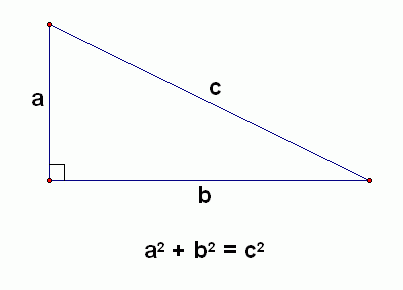
For calculating the angle:
Physics behind a roller coaster!
Although i have "ride-phobia" and i have never even been on a merry-go-round but however all those big rides always make me wonder that what makes them work? Today we are going to discuss the king of rides- the roller coaster! Have you ever considered that what makes a roller coaster work? The answer is kinematics! Kinematics is the the study of motions. From studying kinematics we can know the acceleration, position, time taken, displacement and velocity of a certain object.
The three laws of Newton that apply to the roller coaster are:
1) "All objects will remain in a state of rest or continue to move with a constant velocity unless acted upon by an unbalanced force."
2) "The acceleration of an object depends inversely on its mass and directly on the unbalanced force applied to it."
3) "For every action force, there is an equal and opposite reaction force."
With the help pf these three laws and kinematics one can understand the physics behind a roller coaster and can even build one.
Another important thing behind the physics of the roller coaster is the law of conservation of energy. This law states that the energy cannot be created or destroyed. We know that energy therefore converts from one form to another. In a roller coaster, the potential energy is converted into kinetic energy and vice versa. Not only this but a roller coaster may convert and transform this energy in several different forms such as heat energy and light energy.
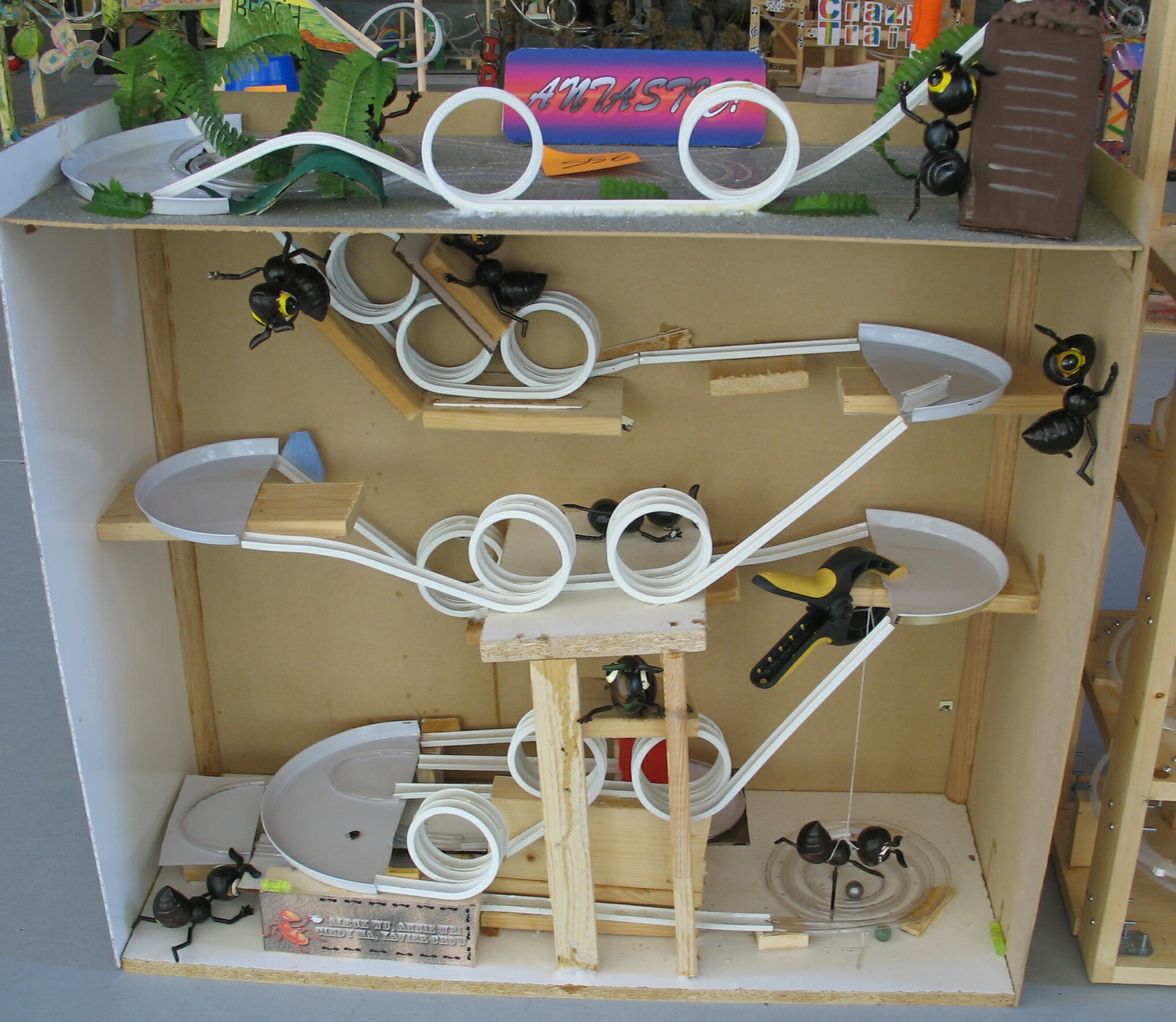
The picture of roller coaster given below won first place for technical merit in 2009 and was made by the students of A.Y Jackson!
Wednesday, October 13, 2010
Motion Activity
The red line shows our result that we got after walking hundred times on one graph.

- Walk 1m for 1s
- Walk away from the motion detector at a constant speed for 2s
- Stay for 3s at 3m
- Walk towards the motion detector for 2s at a constant speed
- Stay about 2m until the garph finishes

- Start at 3m walking towards the sensor at a constant speed for 3s.
- Stop at about 1.5m for 1s.
- Walk towards the sensor at a constant speed for 1s.
- Stop at 0.5m for 2s.
- Walk away from the sensor at a constant speed for 3s

- Stay at any position for 2s.
- Walk away from the sensor at a constant speed of 0.5m/s for 3s.
- Stay for 2s.
- Walk towards the sensor at a constant speed of 0.5m/s till the end.

This was our fourth graph and also the HARDEST one! I dont remember who got this one but im pretty sure we got it after atleast a million tries -_-''! For this graph:
- Speed up at a constant rate for 4s walking away for the sensor.
- Stop for 2s.
- Walk towards the sensor at a constant speed for 3s.
- Stop till the end.

This was our fifth and one of the easiest graphs. We all tried it and all of us got the results pretty good but than this was the perfect one and we chose it! For this graph:
- Walk away from the sensor at a constant speed for 3.5s.
- Stop for 3.5s at 2m
- Continue walking away from the sensor at a constant speed till the end of the graph
Graph G

This was our last graph and also one of the hardest ones. We spent most of the time on this graph. But we still dint get results close to the graph that was given and gave up on it. For this graph:
- Walk away from the sensor at a constant speed of 0.3m/s for 3s.
- Walk towards the sensor at a constant speed of 0.3m/s for about 4s.
- Stop till the end of the graph.
Saturday, October 2, 2010
Motor Activity
On Thursday me and my class was assigned to make a motor on our own with a little help from our partner and teacher. I was lucky enough to be grouped with my friend Hazra and i was very happy as we make a great group together.
Thanks to Hazra because without her it would been almost impossible for me to build this motor on my own and as we had better understanding before, she made it easier for me and i think we did a fantastic job together!


Before we started building the motor, I was very nervous and i had doubts about the task that i was about to do. I thought our never would never work because it is harder for girls to build motors and work with electricity. But soon our teacher Mr:Chung told us that the best motors from the past were from the group of girls.
Finally me and Hazra started building the motor. We decided to divide the tasks so that we could finish the motor by the end of the period. Hazra started with hammering the nails into the wooden board while i was sanding the pop can from both sides. I thought sanding the pop can would be easy but i was wrong. I did not only sand the pop can but i also figured out that i was sanding my nails and fingers too. After Hazra was done hammering the nails, she started putting the axel in the cork. We figured out that axel would not go in cork directly so i helped hazra hammer a nail into the cork so that the axel could go in. Finally it did and than i started sanding back the pop can. This task took too long than i had expected. After we realized that we were working too slow and we had to hurry up in order to get the motor working by the end of the period. Therefore Hazra started coiling the coil wire around the cork while i was sanding the two ends of the wire. After we were done coiling the wire around, we started inserting the brushes on to the sides. Though the brushes were in its proper place but the thumb stacks did not hold them tightly and the brushes kept bending towards the bottom. Hazra gave up on this task and started putting the paper clips as the support for the axel on the board. While she was doing so, I was fixing the brushes and finally we were done. Everything was in its position and it looked fine. We were the first ones to finish and we took our motor to out teacher for testing. Mr:Chung tried it but we failed for the first time and it did not work. He told us that we need to coil the wire the other way round around the cork. We took our motor back and uncoiled the cork. After we were done coiling the wire the proper way, we figured out that we our brushes were again bending towards the bottom. I tried to fix it as soon as i could but meanwhile James and Tomeo were done and their motor worked perfectly fine.
Finally we took our motor for testing. As Mr:Chung was about to test it, I started praying to God because this time i felt like giving up after working non stop on this one little motor. But this time our motor actually worked. Though our motor was not the first one to work but I was very glad that it finally worked and we were successful. I felt really proud of myself because at the beginning I thought that this task was next to impossible for me but I am very glad that i was not only able to finish it but also do it before others!!! :DThanks to Hazra because without her it would been almost impossible for me to build this motor on my own and as we had better understanding before, she made it easier for me and i think we did a fantastic job together!


Subscribe to:
Posts (Atom)